
Executive Summary
Combustible gas instruments report what they sense in one of three scales: parts per million (ppm), percent of the lower explosive limit (%LEL), or percent by volume (%vol). Confusing one for another is one of the most common, and most consequential, mistakes in the field.
A reading of “50” on a leak survey instrument displaying ppm means five thousandths of a percent of methane in air — an indication there is a leak somewhere. A reading of “50” on a confined-space monitor displaying %LEL means the atmosphere is halfway to the explosive range. Same number, different decisions, different urgency.
This paper is written for the three groups who read these instruments every day: walking-survey technicians, fire and emergency response crews, and the supervisors and trainers who set their habits. It explains what each scale measures, where each is used, the most common misinterpretations we see in the field, and how trainers can help prevent avoidable mistakes.
Key Points:
- Three scales answer three different questions. ppm is typically for trace detection and leak finding. %LEL is for combustibility risk. %vol is for rich-atmosphere awareness and asphyxiation hazards.
- The action threshold is set by policy, not physics. Some U.S. gas utilities act at 20% LEL; OSHA defines a hazardous confined-space atmosphere at 10% LEL; some operators alarm earlier. The instrument does not know your policy — the operator does.
- A falling reading is not always good news. A gas-and-air mixture above the upper explosive limit (UEL) can show a low or zero %LEL reading on a catalytic-bead sensor while still being extremely dangerous.
- Trainers should anchor each scale to a decision, not a number. The fastest way to reduce misinterpretation is to teach “what does this reading tell me to do?” before “what does this reading mean?”
Why This Matters
Most combustible gas mistakes in the field are not sensor failures. They are interpretation failures. A technician sees a number, makes a decision, and moves on. If the number was on the wrong mental scale — or compared to the wrong threshold — the decision can be wrong even though the instrument was working perfectly.
Two trends have made this harder, not easier. First, modern multi-gas instruments commonly show several scales at once or switch between scales automatically depending on concentration. Second, the workforce reading those instruments is turning over. New hires inherit habits from senior technicians without always inheriting the reasoning behind them. The result is a training gap: people who can read the screen, but cannot always explain what the number means or why the threshold is what it is.
This gap shows up in three predictable ways. Crews can escalate small ppm-level indications as if they were imminent explosion hazards or dismiss small %vol readings as not nearing the explosive range. It’s also possible to assume a sudden drop in %LEL as a leak “clearing” when it may be the atmosphere passing through the explosive range into a rich, oxygen-displaced state. Supervisors and incident commanders should not accept readings without asking the question that determines the right response: which scale am I looking at?
False escalations consume crew hours and erode credibility with customers. Missed escalations are how near-misses become incidents. Both are preventable with training that treats the scale, not just the number, as the primary fact on the screen.
The Science
The Combustion Triangle
Combustion needs three things at the same time: a fuel, an oxidizer (almost always oxygen from the air), and a source of ignition energy. This is the combustion triangle. Sometimes drawn as a fire triangle, and sometimes expanded to a fire tetrahedron when the self-sustaining chemical chain reaction is shown as a fourth element. Remove any one side and combustion cannot occur.
Combustible gas instruments measure the first side of the triangle: how much fuel is in the air. A multi-gas monitor with an oxygen sensor measures the second side separately. Instruments cannot tell you whether an ignition source is present. When a reading is interpreted, all three sides need to be in the operator’s mind at once. However only one or two of them is on the screen.
LEL and UEL: The Explosive Range
Every combustible gas has a concentration range, in air, where it can ignite. Below the Lower Explosive Limit (LEL), there is not enough fuel and the mixture is too lean to burn. Above the Upper Explosive Limit (UEL), there is too much fuel and not enough oxygen and the mixture is too rich to burn. Between LEL and UEL is the flammable range, and that is the range that puts people and property at risk.
For methane, the main component of natural gas, the LEL is approximately 5.0% by volume and the UEL is approximately 15.0% by volume in air under standard conditions. These values shift with temperature, pressure, and oxygen concentration, but the textbook 5%–15% range is the one we see trainers anchor to.
Why the LEL Action Threshold Is Not Always 5% Volume
It is common to hear “5% is the LEL,” and that is true as a physical fact for methane. But operators do not act at 5% volume in air. They should act at a fraction of LEL determined by their own policy and the regulation that governs the work.
OSHA defines a hazardous atmosphere in a permit-required confined space as one containing flammable gas in excess of 10% of LEL (29 CFR 1910.146). Most U.S. gas utilities follow GPTC leak-classification guidance, which uses 20% LEL and 80% LEL as the boundaries between grades of leaks in confined spaces or substructures. Many operators set instrument alarms at 10% LEL or 20% LEL by policy.
The point is not which threshold is correct. The point is that the threshold lives in the policy, not in the instrument. Trainers should make sure every operator knows their own employer’s action levels by heart and knows where to find them if they need to check them.
Three Scales, Three Questions
The same physical concentration of methane in air can be expressed in any of three units depending on the instrument and the use case. Operators who are able to think in all three are less likely to confuse a reading.
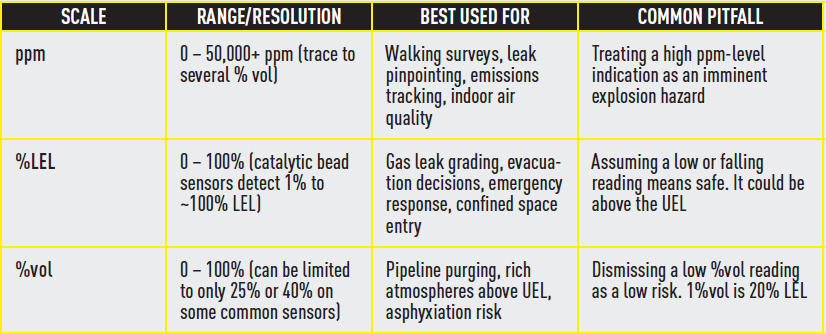
Parts per million (ppm) is typically the trace-detection scale. One ppm is one part of gas in one million parts of air. ppm readings answer the question “is there any gas here, and where is it coming from?” Leak survey instruments and remote methane laser detectors typically report in ppm based scales at low concentrations because at the trace level, that is the only scale with useful resolution.
Percent of LEL (%LEL) is the combustibility scale. A reading of 100% LEL means the atmosphere is at exactly the lower explosive limit. A reading of 50% LEL means it is halfway there. %LEL answers the question “how close is this atmosphere to being able to burn?” This is the scale that drives evacuation alarms and confined-space entry decisions. Percent by volume (%vol) is the bulk-concentration scale. It answers the question “how much of this atmosphere is gas?” %vol matters in two situations: when concentrations are above 100% LEL, and when displaced oxygen has become the dominant hazard. For methane, 100% LEL equals 5% vol, and 100% vol is pure methane with no air and well above the UEL.
The conversion between the scales is straightforward: 10,000 ppm equals 1% by volume; for methane, 1% by volume equals 20% LEL (because 5% volume is 100% LEL). Memorizing those two equivalences is one of the single most useful piece of mental math an operator can carry into the field.
Side-by-Side: What Each Scale Tells You
Common Misinterpretations In The Field
These five are the most common patterns SENSIT hears about from trainers, supervisors, and instructors who run training classes. None of them are complex and that is the point. They are easy mistakes to make precisely because the readings look reasonable on the screen.
1. Reading A Number Without Checking The Units
A two-digit number on a screen is just a number. A reading of “50” on one display could be half a percent by volume of methane in air; on another display, it is half the lower explosive limit and on the other display it’s a small trace of gas. The numerical value is the same. The hazard interpretation is twenty times apart. Trainers should drill the habit of saying the units out loud every reading, every time.
SENSIT multi-gas instruments display the units they are indicating next to the number to remove doubt over what scale is being used.
2. Assuming A Single, Fixed Action Threshold
Operators who move between employers, contractors, and response teams sometimes carry one company’s alarm set point in their head as if it were a regulation. It is not. For some the 10% LEL threshold applies and for others the gas-utility leak classification of 20% LEL may apply. Fire-service standard operating guidelines may set a different threshold for offensive vs. defensive posture. The right number is the one in the operator’s current employer’s procedure and not the number they remember from their last job.
SENSIT multi-gas instruments have programmable alarm levels. During the ordering process instruments can be specified to be set up to match existing work practices or procedures.
3. Mistaking A Falling Reading For A Clearing Atmosphere
On a catalytic-bead combustible gas sensor, the displayed %LEL value rises with gas concentration, peaks near 100% LEL, and then can fall as the atmosphere becomes too rich for complete combustion at the sensing element. A reading that drops from 90% LEL toward zero is sometimes a leak that is clearing and sometimes it is an atmosphere that has passed through the explosive range into a rich, oxygen-displaced state. The companion signal is the oxygen reading. If %LEL is falling and O₂ is also falling, treat the area as more dangerous, not less.
SENSIT multi-gas instruments will often come with oxygen sensors and be able to measure gas up to 100%vol to help operators manage situations where the quantity of gas is above the UEL.
4. Forgetting That The Calibration Gas Matters
Most combustible gas instruments are calibrated to a specific reference gas (commonly methane). When the instrument encounters a different combustible gas (such as propane), the displayed %LEL value is approximate. A combustible gas sensor calibrated for methane will respond to propane, gasoline vapor, or hydrogen, but the relationship between the displayed reading and the true %LEL depends on the response factor for that gas. Operators do not need to memorize the response factor table; they do need to know what gas their instrument is calibrated for, and to flag readings when the suspected source is something different.
SENSIT multi-gas instruments are available with a selectable propane mode and can be calibrated to both methane and propane. This helps gas utilities and first responders handle investigations at locations where both fuels are present.
5. Treating a ppm Leak Survey Reading With Incorrect Urgency
Leak survey instruments report in ppm because that is the right scale for finding small leaks during walking or vehicle-mounted surveys. A 200 ppm indication near a service line could be a natural gas leak to investigate further not an immediate explosion hazard, because 200 ppm is only 0.4% LEL for methane. The opposite mistake can happen too: a 200ppm reading above ground near a foundation should trigger a below ground leak investigation as it could be nearing %LEL where the gas line enters the property.
SENSIT instruments are available with a range of modes to support leak investigations. Leak search mode on a multi-gas detector helps with ppm scale investigations. Bar hole modes help with pinpointing and grading below ground leaks. Talk to SENSIT about how each instrument can support leak investigations.
Training Tips for Supervisors and Instructors
These are non-procedural training habits that build the right kind of pattern recognition. They do not replace any employer’s standard operating procedures they are intended to support them.
Anchor Every Reading To A Decision
Operators remember decisions better than numbers. When introducing a scale, lead with the choice the number drives: enter, evacuate, ventilate, escalate, investigate. The number is the input; the decision is the output. New technicians who learn the decision first can internalize the scale faster than those who learn the number first.
Drill The Three-Scale Handoff
Pose scenarios that walk a crew through all where all three scales can be used on the same incident: a ppm-level survey indication outside a building, a %LEL reading on entry, a %vol reading in a rich pocket (or barhole) near the source. The point is not to test whether they remember the numbers. The point is to build the habit of switching mental models when the scale changes.
Say The Unit Being Used Out Loud, Every Time
This helps with communication between utilities and fire departments. “Ten percent LEL” and “ten thousand ppm” carry very different information. “Ten thousand ppm” is double “Ten percent LEL”. Crews who don’t say the unit on the radio risk the numbers being applied to without context. Trainers can correct this in minutes and the habit can last for years.
Teach The UEL, Not Just The LEL
Most training emphasizes the lower limit because that is where small gas leaks become big risks. Crews who understand the upper limit make better decisions in the moments that matter most. Venting a gas filled space that is above the UEL creates a risk that didn’t exist before the venting action was taken.
What This Means In The Field
For Front-Line Operators
Read the scale and the number. Every time. If your instrument shows ppm at low concentrations and switches to %LEL above a threshold, know what that threshold is and know how the screen will change. Carry the two conversions: 10,000 ppm = 1% volume, and 1% volume of methane = 20% LEL. Use those two facts to sanity-check any reading that surprises you and don’t argue with the oxygen sensors reading as that should inform your decision also.
For Supervisors And Trainers
The cheapest improvement in field accuracy is verbal discipline: require the unit to be stated every time a reading is exchange between crews or between the utility and the fire department. The second cheapest is regular scenario drills that cross the three scales on a single incident. Look for technicians who can explain why their action threshold is what it is, not just what number it is.
For Fire Service And Emergency Response
On a gas emergency, the instrument scale matters as much as the reading. A handoff between the first-arriving engine, the gas utility crew, and the incident commander should include the scale, not just the number. Also make the UEL part of the briefing, not just the LEL.
Summary
Combustible gas instruments give you accurate readings. The interpretation of their readings can be what fails. Three scales, ppm, %LEL, and %vol, answer three different questions and an operator who cannot tell you which scale they are reading cannot tell you what the reading means. The lower explosive limit defines where the atmosphere becomes flammable; the upper explosive limit defines where it becomes too rich to burn but that does not mean it becomes safe. Then the action threshold an operator works to is set by employer procedure, not by physics.
Training that anchors each scale to a decision, drills the three-scale handoff, and teaches the UEL alongside the LEL is the most effective way to reduce both false escalations and missed hazards. SENSIT instruments across our range are designed to make the active scale unmistakable on the display and are there to help the operator during an investigation. The rest is training.
If your organization is updating its gas-detection training program or rolling out new instruments to a crew that has used a different platform for years talk to SENSIT. We work with utilities, fire services, and industrial customers on training materials and field reference cards that make the three-scale habit second nature.
Frequently Asked Questions
LEL stands for lower explosive limit (sometimes called the lower flammable limit, or LFL). It is the minimum concentration of a combustible gas in air below which ignition cannot be sustained. For methane, the LEL is approximately 5% by volume in air.
LEL is the explosive-risk scale; ppm is the trace-concentration scale. They measure the same gas in different units and answer different questions. For methane, 10,000 ppm equals 1% by volume, which equals 20% LEL.
No. For methane, 5% by volume is 100% LEL (the full lower explosive limit). 5% LEL is one-twentieth of that (approximately 0.25% by volume, or 2,500 ppm).
UEL stands for upper explosive limit. It is the maximum concentration of combustible gas in air above which the mixture is too rich to ignite. For methane, the UEL is approximately 15% by volume. Fire departments need to know about the UEL because an atmosphere above the UEL can read low or zero on a %LEL catalytic bead sensor while still being extremely hazardous. The risk can come when the atmosphere clears back through the explosive range if it is ventilated or if more air mixes in.
That depends on your employer’s procedure. OSHA defines a hazardous confined-space atmosphere at 10% LEL. Many U.S. gas utilities act at 20% LEL based on GPTC leak-classification guidance. Some operators alarm earlier. The instrument follows whatever threshold is programmed; the right number for your work is the one in your own procedure.
On a catalytic-bead sensor, the reading depends on combustion at the sensing element. Above the upper explosive limit (or in an atmosphere where oxygen has been displaced) the sensor cannot fully oxidize the gas and the displayed %LEL falls. Always check the oxygen reading. If %LEL is falling and O₂ is also falling, treat the area as more dangerous, not less.
Terms and Definitions
Calibration
an adjustment of an instrument’s response against a known gas standard, typically performed on a scheduled interval. Calibration confirms accuracy.
Catalytic-bead Sensor
a combustible gas sensor in which gas is oxidized at a heated catalytic element, producing a temperature change that is read as a Wheatstone-bridge imbalance. Typically detects 1-100% LEL; requires oxygen to function.
Combustion Triangle (Fire Triangle)
the three elements required for combustion: fuel, an oxidizer (typically oxygen),
and ignition energy. Sometimes shown as a fire tetrahedron when the self-sustaining chain reaction is included as a fourth element.
LEL (Lower Explosive Limit)
the minimum gas-in-air concentration at which combustion can be sustained. For
methane, approximately 5% by volume.
LFL (Lower Flammable Limit)
similar to LEL; sometimes used interchangeably in U.S. and international standards.
ppm (Parts Per Million)
a unit of trace concentration. 10,000 ppm equals 1% by volume.
UEL (Upper Explosive Limit)
the maximum gas-in-air concentration above which combustion cannot be sustained
because there is too little oxygen. For methane, approximately 15% by volume.
%LEL (Percent LEL)
the displayed concentration as a percentage of the lower explosive limit. 100% LEL means the
atmosphere is exactly at the lower explosive limit.
%vol (Percent Volume)
the displayed concentration as a percentage of the total atmosphere. 1% vol = 10,000 ppm.